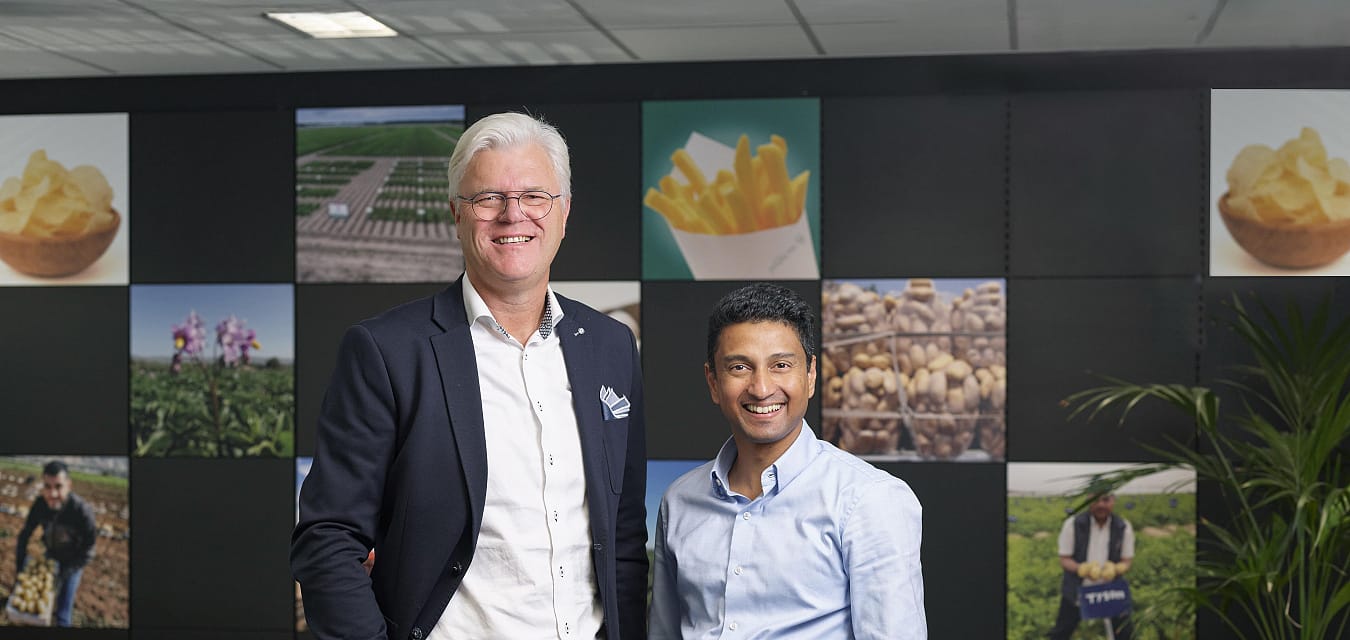
Peter & Rutvik - Managing Director & Commercial Manager, STET Holland
The best seed potatoes come from the Netherlands. One of the key players in this field is STET Holland: a global market leader in seed potatoes for chip production. "There is always a certain tension and dynamism in the work."
Peter & Rutvik - Managing Director & Commercial Manager
Just before the export season kicks off, it's busy at the STET Holland office in Emmeloord. Sales managers are working on the distribution of seed potatoes, product managers are discussing new varieties, and there are intense discussions with the logistics department about shipments to distant destinations. Amidst this activity, we speak with Managing Director Peter Ton and Commercial Manager Rutvik Patil.
Peter, you have been involved with STET since 1990. What makes the seed potato world so interesting to you?
"The potato is a crucial crop in the Netherlands, and the sector remains interesting due to its dynamism. We are constantly faced with challenges, such as drought, economic issues, and political instability in our markets. Although it is a traditional sector, the arrival of hybrid potatoes will bring about significant changes. At the same time, we are dealing with current challenges, such as climate change and the growing need for more robust varieties."
Rutvik: "We export to fifty different countries, so there is always something happening somewhere: a war, economic problems, or logistical challenges."
What are the main challenges you are currently facing?
Peter: "Climate change is a major challenge. Potatoes are vulnerable, and there is still a need for crop protection products to keep them healthy. Our priority is to quickly develop genetics that are stronger and more robust, so we can reduce the use of chemicals."
Rutvik: "The second challenge also presents opportunities: the shift from exporting to local cultivation in the destination country. Customers increasingly want local production, but they still rely on our genetics and knowledge. We must ensure that our varieties are suitable for local multiplication, for example, in Egypt."
What is your market position like?
Rutvik: "We are the third trading house in the Netherlands, after Agrico and HZPC. In specific segments, such as chips, we are even the market leader. Our focus is on Western Europe, around the Mediterranean region, North Africa, and the Middle East."
Isn't it difficult to compete against the giants?
Peter: "In the past, sometimes it was, but since the acquisition of KWS Potato in 2016, we have achieved an economy of scale. Yes, we are smaller, but we are a strong number three with our own focus."
Rutvik: "As a sister company of HZPC, we have access to top genetics and we share expertise and overhead. Among seed potato companies of similar size, no one has as good a breeding company as we do. The best part? We only do what we are really good at."
And what is your strength?
Rutvik: "We are a market leader in chips and strong in the early export of seed potatoes for the fresh market. These are deliberate choices; the chips market is more manageable than fries and often offers added value."
Rutvik: "What sets us apart is that we involve major chip producers early in our variety development. This is less common among the major seed potato companies that aim to serve the global market. We often focus on one customer per country and work closely with them."
What is STET's ambition for the coming years?
Peter: "We aim to grow by 50 percent in five years, requiring annual double-digit growth rates. The challenge lies in new business models, as land is scarce in the Netherlands. Innovation and tapping into new markets are essential. The ambition is significant, and the joy we find in it as well."
Talking about fun... Rutvik, you have been working at STET for four years now, after over 4 years at HZPC. Can you tell us more?
Rutvik: “We have a flat organization with short lines of communication. Everyone gets a lot of responsibility and space for their own initiatives. We work closely together and there is a friendly atmosphere. In addition to quarterly meetings, we also gather throughout the year for a barbecue or Christmas dinner. This way, we also get to know each other's partners and children. STET still has something of the old family business. At the same time, we are a true trading company, so there is always a certain tension and dynamism in the work.”
Is that tension mainly in the work of the sales managers?
Peter: “Indeed. It's not just about maintaining relationships, but also about sensing what is happening in your region and how it affects your business. You need to stay in continuous contact and manage expectations well. Our product grows in the field. Sometimes the amount of available product is 10 percent above or below our sales expectations. These fluctuations are not always ideal for customers and growers, but they make our work extra interesting.”
You need to be able to handle those fluctuations.
Rutvik: “That's right. As a sales manager, you need to be flexible and deal with changes and diverse cultures. In the EMEA region, it is essential to stand your ground firmly. You need to communicate quickly and clearly and make decisions, for example, in a deal in Egypt, without first consulting your legal team in Emmeloord.”
What makes working at STET attractive?
Rutvik: “It's a combination: an international environment with a lot of variety and seasonal work pressure. In addition, there are plenty of growth opportunities, both within Stet and the broader HZPC group. I am a great example of that myself.”
Ready to take the next step? Then contact us..jpg)
Photographer: Pim van der Maden
[Published: October 2024]