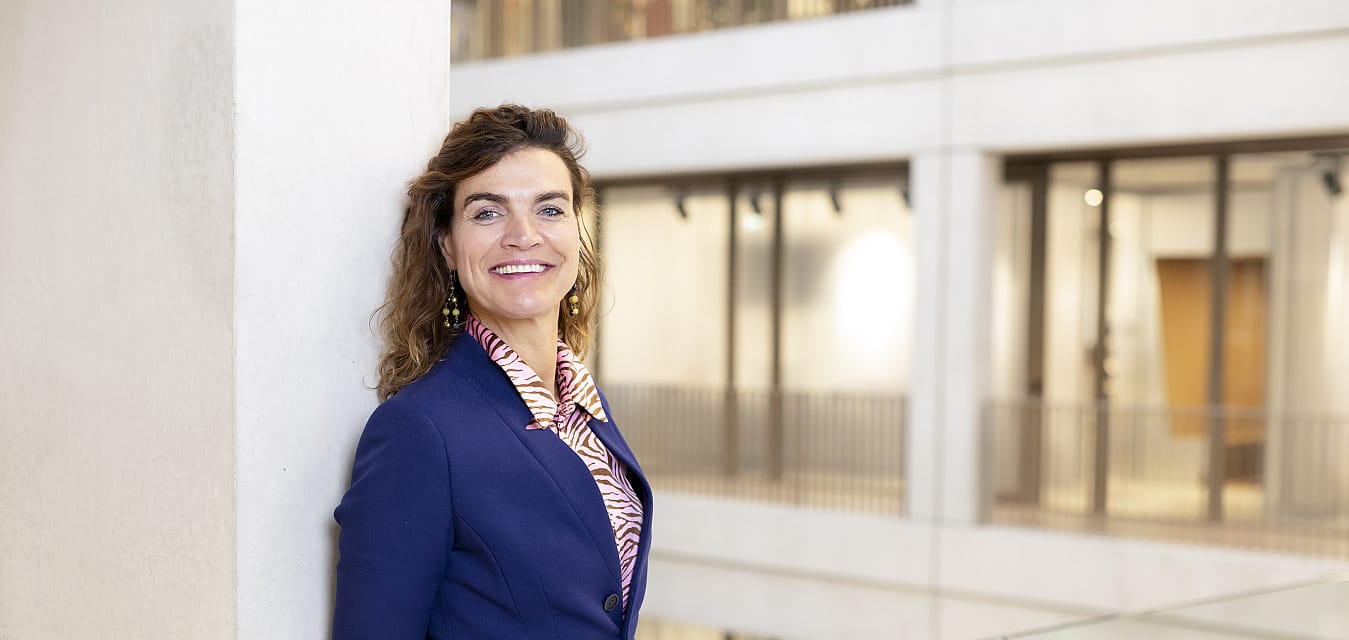
Marjolein Brasz - CEO, Foodvalley
Being comfortable with being uncomfortable. That's what Foodvalley CEO Marjolein Brasz has taken further in her career each time. Not to an oil rig, because they don't want business administrators there, but to London, Sri Lanka, and interesting C-level positions.
Marjolein Brasz - CEO
The usual career path is to start working after graduation and gradually climb higher on the career ladder. However, this is not the case for everyone. For Marjolein Brasz, it became an exploration to the place where she makes an impact, has a mission that aligns with her values, and where she doesn't have to stay within the lines.
First back to the beginning when you were studying business administration at Erasmus University. Was there a plan behind it?
"It's a versatile study, which suits me, with the possibility of an international career. In what form or at what type of company; I hadn't thought about that. In 2000, there were still many business markets with mainly FMCG, consultancy, and the energy world. There wasn't much choice offered. We would always need energy at least."
Did you choose the energy sector for your thesis because of that?
"Yes, I could see myself working there. At Shell, I wrote my thesis on the topic of global virtual teamworking. For a company with offshore activities and collaborations in different departments, time zones, and cultures, an extremely relevant theme. To work well in a hybrid way, of course, the right tools are needed, but what it really comes down to is: 'How well do you know the other person?' If the collaboration is good, you can work remotely just fine. The thesis was ultimately relevant throughout my entire career. Even 20 years later when I started at FoodValley during the coronavirus crisis and COVID-19 was rampant."
Tell us about your first job at ExxonMobil. What ambitions did you have then?
"I wanted to work offshore; sitting on an oil rig for 6 weeks and then traveling for 6 weeks seemed appealing to me. But let me tell you; they don't want business administrators on an oil rig. What ExxonMobil could promise, however, was that I could go abroad after a few years. So, I started my first job as an analyst at Gasunie's joint venture. I advised the country manager Benelux in shareholder meetings and contributed to the long-term vision, policies, and decisions. It involved subjects like gas from the North Sea and import-export contracts."
Wasn't that challenging for a first job?
"It was an interesting job, a bit too much Excel spreadsheet management though. As the next step, I was involved in preparing for the dismantling of the gas house based on European legislation. I conducted due diligence, managed a team, and did some modest lobbying. Eventually, trade and transport were separated; transport came under the government, and trade became private."
You wanted to go international. When did that moment come?
"Three years later, I left as an expat to London. I lived in Notting Hill and mainly attended all club and restaurant openings. It was fantastic. For ExxonMobil, I worked on NGL and was commercially responsible for the terminals where the gas arrives. There, I realized a few things. Firstly, that as an entrepreneurial type, I didn't really fit well into the company. In a company with billions in assets, everything is focused on production and the related safety. This has limitations on how you work and how free you can be. I also like to think outside the box if it benefits the situation. Furthermore, the work content didn't quite align with my interests and talents. And lastly, certainly not unimportant, I began to realize more and more that as a society, we need to transition to more sustainable forms of energy, and there was little attention to that at ExxonMobil. In short: how I envisioned my future differed too much from what I was doing."
How do you look back on that period now?
“It was a valuable employer, because you are well trained and super well trained. I learned how to work efficiently, create business cases, lead meetings, and build consortia.”
And what about then? How did you move on?
“On my way to Sri Lanka for a holiday, a tsunami (26 Dec. 2004) struck: I arrived in a country in chaos. Eventually, I put my stuff in a locker at the airport and helped with the initial relief efforts on the south coast, as the large-scale aid didn't really get going. I helped at a field hospital, with water and food distribution, and assisted the injured. This international experience in a completely different world than I was used to became a turning point for me.”
Most people would book the next return flight in the face of such adversity. Why didn't you?
“It was such a huge disaster. I wanted to help! The combination of adventure and diving into something also plays a role. But above all, wanting to do something, achieve something, that suits me. That's how I look at life. An expat job pays well, but what's more important to me is that it aligns with my values. Where can I make the most impact? What can I learn and do? And where can I use my talents to make a difference?”
At some point, your 'holiday' was over. What did you do then?
“I had already extended my holiday by a few weeks, and when I returned to London, there was so much attention on this disaster. Additionally, I had a lot of film and footage, so I quickly raised a lot of money through business relationships. I returned to Sri Lanka to set up projects with other parties unpaid to rebuild the country. Think of money for hostels, a few rooms, a kitchen to revive tourism, a fish market, a bakery, and out of personal interest, a music school. I could have returned to a similar position at ExxonMobil, but I ultimately didn't, I was looking for my best fit. Unfortunately, I had a motorcycle accident at some point.”
Oh dear. Did that accident have a big impact?
“Quite a bit. After a few weeks in the hospital in Sri Lanka, I had to return to the Netherlands, to my parents, for rehabilitation. By now, I was in my late twenties and hadn't lived in the Netherlands for a while, but eventually could live in Amsterdam through anti-squatting. In between surgeries and recovery, I worked as a consultant at Effectory, a market leader in employee research. A wonderful company with a very nice work culture and colleagues. I started to settle in Amsterdam. The search for what I was looking for in my work wasn't over yet, but I could do it just fine from Amsterdam. I had to figure out what type of job, type of company, and mission would ignite me.”
Did you eventually figure out what exactly suited you in terms of work?
“That worked out well! I became Director of Business Development at Avantium Chemicals, a spin-off of Shell focusing on the development of bioplastics and fuels from sugars. The Intellectual Property was based on high throughput technology; we sold this to generate income for further development. This led me to travel extensively abroad to secure new propositions, challenges, clients, and deals, all from my base in Amsterdam.”
With these insights, did you become more focused in your job search?
“Well, a business development role involves a lot of travel, often far from where decisions are made and strategies are determined. I felt the need to convey vision and have a say in decision-making. I applied for the position of Director of Bioenergy & Biomaterials at Ecofys. Later, I also took on the Sustainable Transport department. In this role, I managed 25 consultants across 4 countries. We advised companies on choices regarding the use of biomass in the energy mix, cascading issues, and provided insights to the European Commission and intergovernmental organizations on the sustainability of this system. It was here that I discovered my strength lies in repositioning and restructuring teams, strategy, and focus, and in developing new propositions. Over time, I began to miss having a deeper understanding in this role. Meanwhile, my interest in the systemic nature of the circular economy grew.”
So, focusing on content and the circular economy. Did that work out?
“Yes, because at one point I received job offers from various sources for a role at the Amsterdam Economic Board to establish a circular program for the metropolitan region of Amsterdam in collaboration with professor and former minister Jacqueline Cramer. From her, I learned that it is possible to change an existing system if you approach it systemically. It involves ensuring that supply and demand progress simultaneously. Otherwise, you get stuck in a cycle of: ‘I won't buy it because it's too expensive, there's not enough supply, or it's not good quality’ or ‘I won't produce it because there's no demand, no market, or I won't get enough for it’. Innovations need to be conditioned, the path needs to be paved, and every individual/organization has a role to play in this process. And everything needs to move forward simultaneously. Getting there is an intuitive process. You need to know which individuals you need, the change-makers. They are everywhere; you can recognize them immediately. Additionally, it requires entrepreneurship and the ability to adjust as needed. It's not a straight path, and you must enjoy that.”
What lessons or insights did you gain from this experience?
“Transforming systems is a skill! I understand it and excel at it. I also realized that this field aligns closely with my talents and values, and that I can make an impact through it. Exactly what I was looking for. This position was a clear realization for me of how work can energize you greatly. This expertise and skill set were also sought after at FoodValley. So, you could say that Jacqueline has been a great mentor for me, actually the first one in the workplace. You immediately notice the value of a mentor; it unleashes your strengths. Especially when it's in a place where passion, talent, and experience converge.”
You joined Foodvalley in 2020. What assignment were you given?
“With a new board and new spirit, it is my task to innovate mission-driven towards a sustainable food system. As a practice leader, we help turn plans and ideas into action, collectively. I was not hired for my knowledge of food, as I come from adjacent sectors such as chemistry, energy, bio-based, circular economy, but rather for my way of thinking, who I am as a person, and my approach to driving systemic change. Ultimately, that approach is the same everywhere. By the way, it turned out that I knew the food network quite well, as it strongly overlaps with my previous fields of work; the food system is very broad. Due to my different background, I am not hindered by certain patterns, habits, or thoughts like 'it has been tried before but didn't work.' Along with my intuitive approach, based on experience, knowledge, and extensive interaction with the players in this field, and a business-like approach, this brings a fresh perspective to the organization. These are the prerequisites for change.”
There are currently multiple crises happening in the world, significant innovations in food, and a constantly changing playing field. Isn't that challenging?
“True, but it helps if you are comfortable with being uncomfortable. With every job, I have jumped into something new to learn, to develop, to make even more impact. It always feels uncomfortable, at least in the beginning. We live in a time of transitions; Foodvalley is working on transitions, with organizations and people in transition, that affects you. Our team is also continually in transition. Collectively and individually. It helps to know who you are. The closer you stay to yourself, the better you can deal with change. It helps to have trust, the courage to act, to make choices, and also the courage to ask for help. I just say it when I don't know something. That's not weird at all because none of us know everything. We have to do it together in this complex world. It is then up to me to nourish myself well, provide direction, offer the right structure, and come to a solution together.”
Is that also your advice to professionals who aspire to grow into C-level positions?
“The most important thing is knowing yourself, taking good care of yourself, and trusting your intuition. Once you've made a decision, take the plunge and get started. It starts with self-leadership, and further, a good dose of self-reflection, humor, and the willingness to grow help. Park the ego. It's much calmer. The drive must truly come from within. To reach this point in my life, I had to go through the whole process. I couldn't have done this job 10 years ago. The world is so dynamic that sometimes it feels uncomfortable for me too, but that's also part of it. Otherwise, I wouldn't have stayed in chaotic Sri Lanka back then.”
You must also have certain skills to be a successful leader. What are your strengths?
“A good thinker who also acts, at least that's what I hear from my surroundings. I enjoy setting things in motion. Another thing I'm good at is laughing at myself. According to colleagues, I am persistent and good at separating the essential from the non-essential. When I'm there, I'm there with 100 percent attention. I look at the individual. There's always something I can help someone with. Sometimes just brainstorming, sometimes giving a nudge in the right direction. So, I don't believe in one leadership style. Everyone needs a different approach, which even varies from day to day. With 30 people in the team, it's 30 times different. I find that enjoyable.”
Are you interested in working in this world? Explore your options in our job opportunities or ask our .
CV Marjolein Brasz
2020 CEO Foodvalley
2016 Lead Circular Economy at Amsterdam Economic Board
2012 Director Sustainable Transport, Bioenergy & Biomaterials at Ecofys
2008 Director Business Development at Avantium
2006 Senior Consultant Effectory
2005 Initiator & Project Manager Adopt Sri Lanka
2003 Senior Business Developer at ExxonMobil in London
2000 Analyst at ExxonMobil (Gasunie)
2000 M.Sc. Business Administration at Erasmus University Rotterdam
Current board and advisory positions: societal advisory board at Keygene, chairman investment advisory board fund at Brightlands Venture Partners and non-executive board member at Startlife.
Photo: Barbara Kieboom
[Published: February 2024]