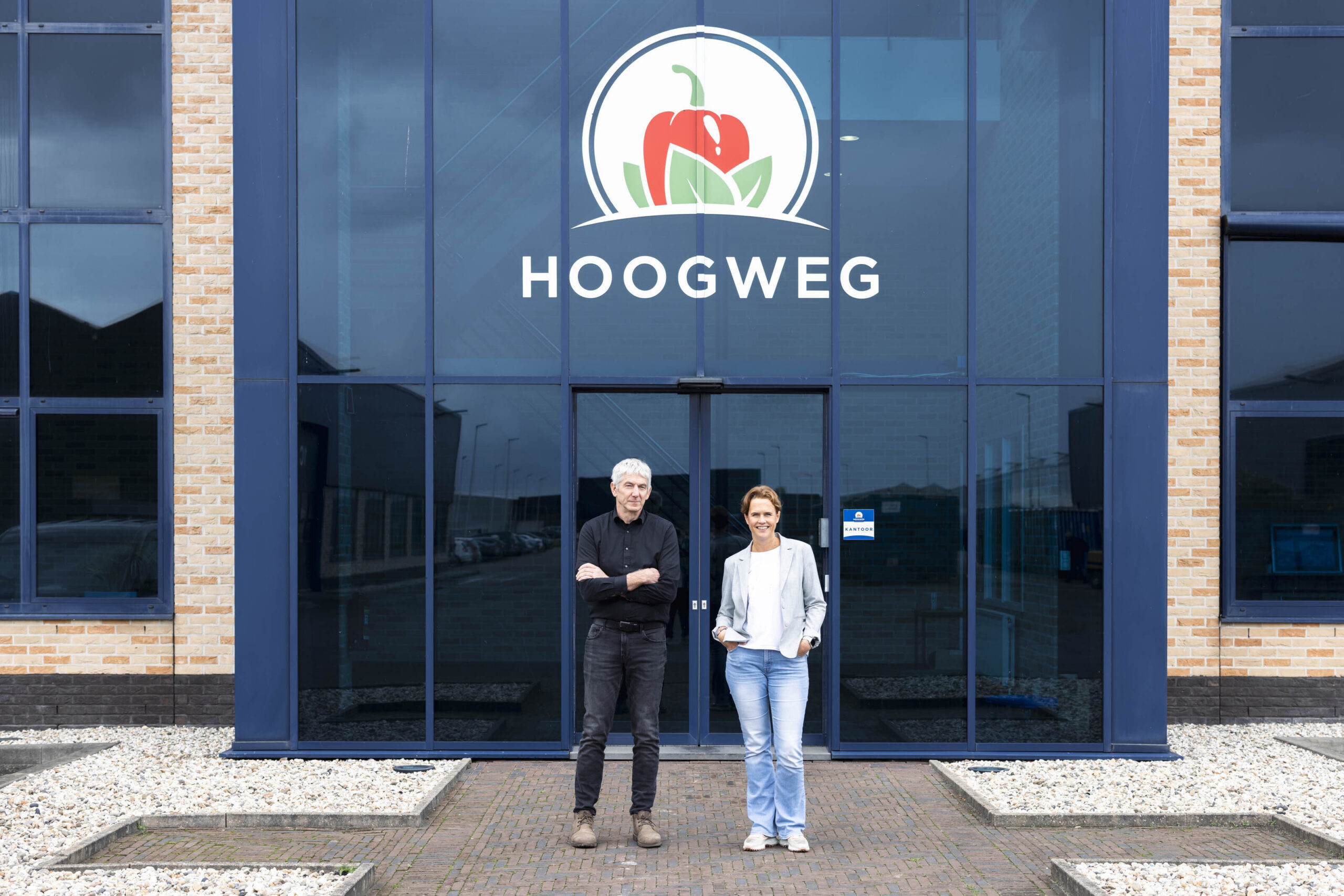
Owner Leo Hoogweg started growing bell peppers on 7 hectares in 1998. The family business now employs around 700 workers at the peak of the season, and next year it will be 850. Annet Hiemstra has been with the company for over a year. She is determined to further promote the company. "Our goal is for anyone looking for a job in the Noordoostpolder to first consider Hoogweg. And know: there is work in various sectors."
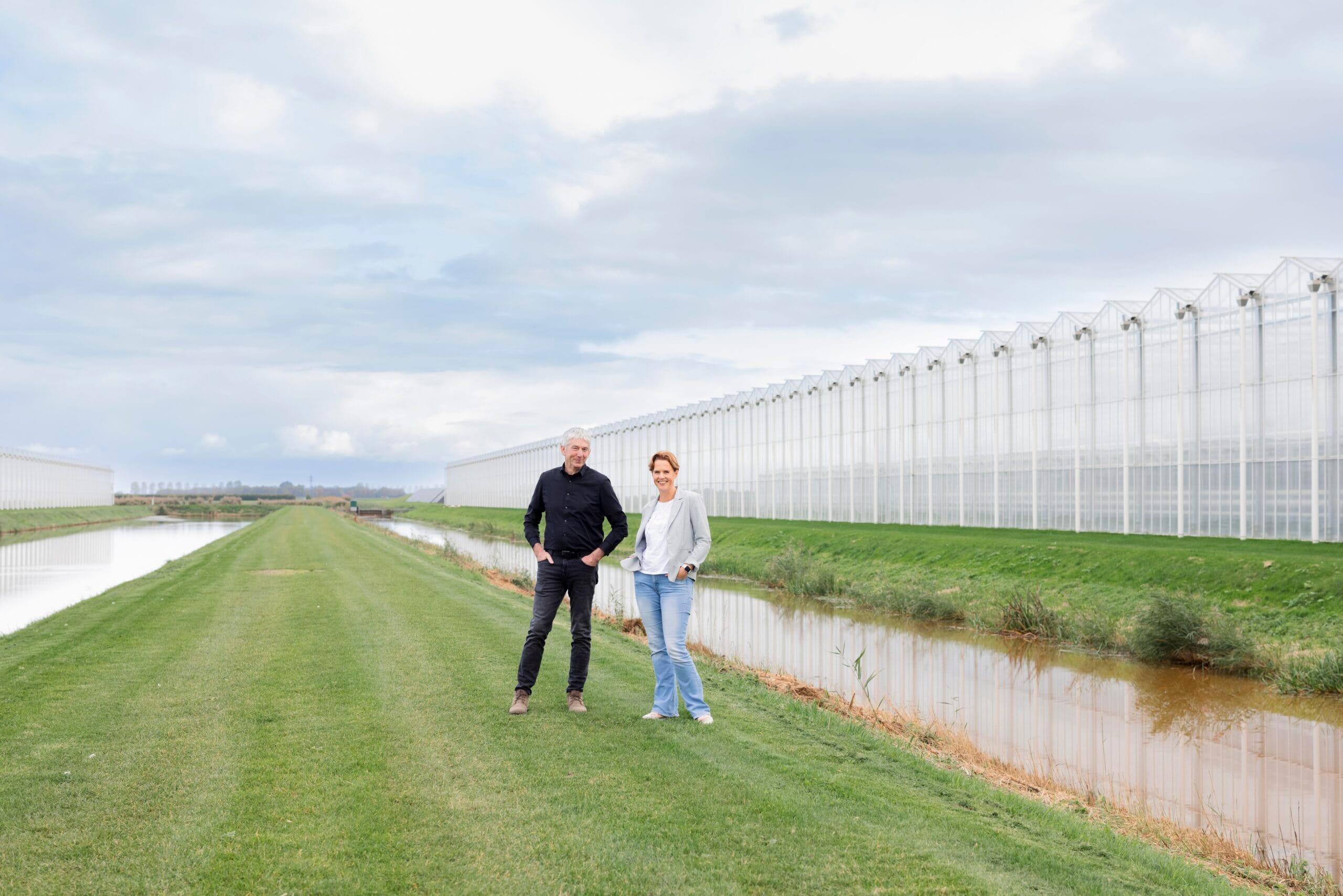
The company has "grown significantly," says Leo Hoogweg with a touch of understatement. We are speaking in the office of the greenhouse complex, in the heart of the company grounds in Luttelgeest. Visitors to the office first pass by hundreds of meters of greenhouses, biomass and geothermal installations, and housing for international employees. Because caring for its people is one of the key points of the family business.
When founder Leo Hoogweg started with 1 hectare of tomato cultivation in 1986, he thought about growth, but not about a company of the current size. After twelve years of growing tomatoes, he switched to bell pepper cultivation in 1998. Due to limited space in the West, Hoogweg Paprikakwekerijen moved to Luttelgeest in 2008. In 2016, Hoogweg started with two greenhouses in Marknesse, followed by two more the following year. Last year (2024), the company opened a third location in Marknesse with the construction of three greenhouses. The total area now covers 190 hectares. With two greenhouses under construction and the acquisition, Hoogweg will have 220 hectares - in other words: 440 soccer fields - spread across six locations.
Why did you choose bell peppers?
Leo: "First of all, for a practical reason. In 1998, I had the opportunity to expand from 2.2 to 7 hectares. Growing tomatoes requires a lot of labor. Bell peppers are more labor-friendly. Also, the bell pepper is a beautiful product. Our mission is to produce high-quality bell peppers in the most efficient and sustainable way."
Are these the ingredients for your continuous growth?
Leo: "Indeed, working efficiently and sustainably provides growth prospects. Scaling up allows for investments, both in energy and in operations. Due to the large scale at which we grow our bell peppers, we can keep the sorting and packaging process in-house. And we have the opportunity to automate these processes. This way, we have the well-known 'traffic light packaging' ready for the customer."
"Furthermore, we ensure that people enjoy working for us, that they come back when the growing season begins again." Annet adds: "We do this by offering good working conditions, but also by creating a family atmosphere in the company. Everyone is treated equally here. There is a Christmas package for the seasonal worker who has worked for a few months, just like for the permanent employees."
Talking about employees: you need hundreds of people every year. How do you find them?
Leo: "That is one of our major challenges. With each growth spurt, we need more people. In winter, we make a theoretical estimate of the number of people we will need for the new season. We try to retain our people as much as possible. There is a group of employees who cut the last bell peppers in November and then go into 'winter sleep'. They make sure they are back in the (early) spring. There is also a group that likes to work year-round, around 250 people next year. They take on all the tasks available in the winter and then move back to crop or packaging work in the spring."
In addition, Hoogweg needs new recruits every year. "We adjust accordingly, based on the start of the season," says Leo. "Many people think that we are not dependent on the weather in greenhouse horticulture, but that's not true. The weather has a big impact on the operations and quality of the peppers. We do not use artificial light and have no production in the winter. Because the pepper flower can only grow with sufficient light." Annet: "A sunny winter means an early Dutch pepper, as in 2025. We already had the first peak week in mid-April. So, we needed extra people early on. We continuously work with temporary employment agencies. On a weekly basis, we know how many people we need."
Annet, you have been working at Hoogweg for a year now. What makes the work here exciting for you?
"I come from the dairy sector, so I knew almost nothing about peppers. That was not a problem. You can learn a lot here. The interesting part about greenhouse horticulture is the great dynamism during the season. Just like during crop rotation. All processes are tightly scheduled one after the other. If there's a problem somewhere, you have to be able to quickly adapt and not panic. I also like the strong drive to improve processes."
"We focus on stabilizing and further structuring the organization."
What still needs improvement at this moment?
"In recent years, a lot of energy has been put into the company's growth. Leo keeps making plans," laughs Annet. "Once the new greenhouses are completed by the end of this year, we will take a step back. We focus on stabilizing and further structuring the organization. We see that we need new people in certain areas now. We used to have twenty to thirty people working in our processing hall. Now, two hundred people are involved in packaging and sorting. This requires an adjustment of the organization and the division of responsibilities. That's why we are now looking for an operational manager for our four processing halls. They will be responsible for the entire process after the peppers are harvested: sorting, packaging, monitoring quality, and internal transport between the different locations, until the peppers are ready on the dock for transport to the customer."
You have more vacancies for key positions. Which ones are those?
Annet: "We are not yet well-known as the employer in the region. That's why we are taking a new step in our HR organization. We are looking for someone to play a key role in attracting talent and strengthening our employer brand. Because based on your abilities and ambitions, you can do a lot here and have a lot of room to grow."
Leo: "Furthermore, we are separating energy and technology at the management level. The new Maintenance Manager can become the point of contact for all machines and installations based on their knowledge and ambitions. This position requires technical insight, but equally important is that the person fits our culture: no-nonsense, approachable, and a strong drive for improvement. We are looking for someone who can lead the team. We have open communication and regular discussions with each other."
Sustainable cultivation is important to you. How do you achieve this?
Leo: "In 2016, we started with the energy transition. We began drilling for geothermal energy. Since 2020, we also have a biomass installation. Currently, we provide over eighty percent of our heat demand in the greenhouses with geothermal energy and biomass. Around fifty percent of our electricity consumption comes from solar panels. During the summer, they generate more electricity than we can use. We then convert the excess electricity into heat through an e-boiler. This way, no energy is wasted. Electricity that we cannot use ourselves is fed into the grid to supply households with power."
Annet: "These investments result in significantly lower CO2 emissions. It is also cost-effective. Due to these investments, we are relatively unaffected by the energy crisis. Our goal is to transition to a fully energy-neutral greenhouse industry by 2040."