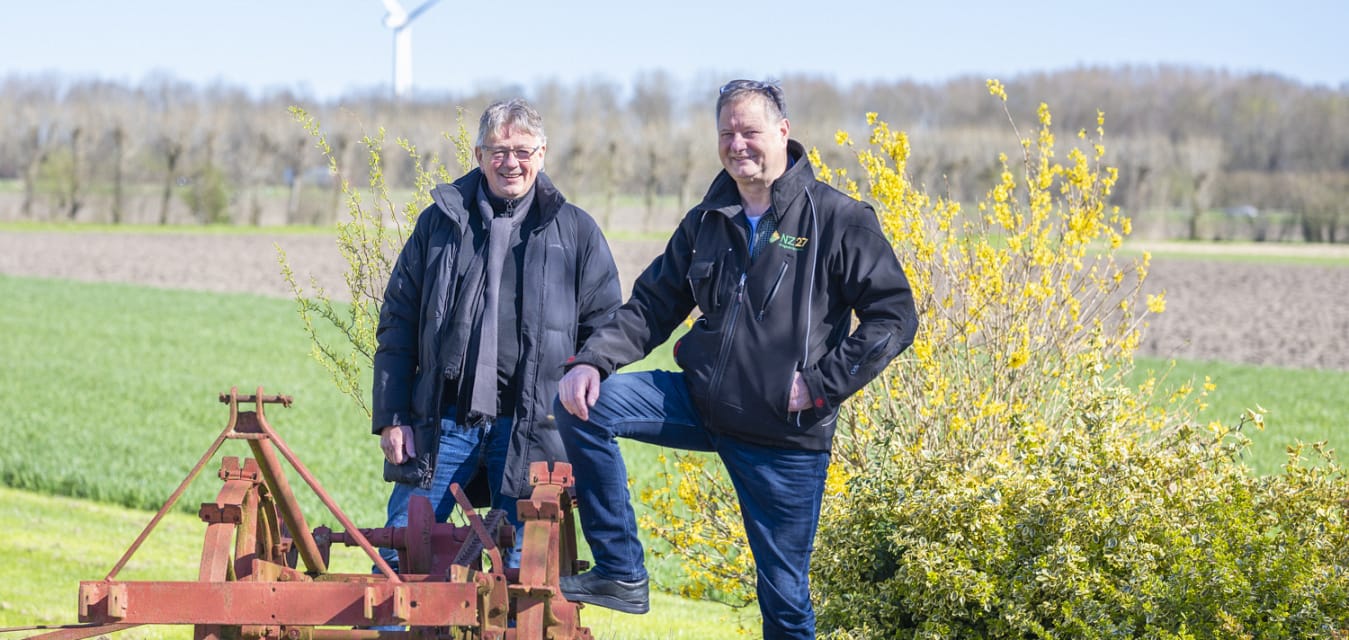
Jules & Douwe – Chairman & CEO, Foundation management NZ27
Biological farm NZ27 in Zeewolde has a unique status. On the fertile grounds where the company farms, no chemical substances have ever been used, and it has a leading role in organic arable farming. 'We show the world how organic farming is possible and how many opportunities it offers.'
Jules & Douwe - Chairman & CEO
One thing is certain: the lands on which NZ27 farms are organic and will remain organic. For eternity. Foundation Management NZ27, chaired by Jules Van Der Weerd, ensures this. 'It is the basis of the arable farming company; a cultivation method that offers many opportunities. Especially looking towards the future where the EU aims for a quarter of organic farming by 2030.' NZ27 has proven for years that it can be a profitable business. Douwe Monsma is at the helm as CEO.
Douwe, the name NZ27 refers to the plot number in Southern Flevoland where the company is located. Where are you now?
D: 'On 210 hectares, we grow organic crops. We do this as climate-neutral as possible; there are four windmills on our lands, and we have solar panels on the roof. We have storage for potatoes and onions of more than 5000 tons, process sweet corn, sort potatoes, and collaborate in the cultivation and vegetable processing company BioBrass with three other organic colleagues. We organize open days, excursions, activities for schools, conduct cultivation trials and variety research with universities and the business sector. Furthermore, we have collaborations with other organic entrepreneurs and participate in various discussions contributing to the development of organic farming. All to introduce farmers and citizens to organic products. Incredibly fascinating.'
What are the biggest recent successes?
D: 'Having vacuum-packed organic sweet corn on supermarket shelves. This way, we bring more margin to the company, and the consumer price of organic is not higher. We see this trend in red beets as well. It is remarkable that it has largely replaced the conventional product, and sweet corn seems to be heading in that direction too.'
Impressive! How did you manage to achieve that?
J: 'As a company, you constantly think about the future. Which direction should we take? Which products will we grow? The director shouldn't just keep things running smoothly, it's really about entrepreneurship, coming up with ideas, and finding ways to do better. As a foundation, we offer the space and opportunities to further expand the company.'
You do so much. What idea is behind that?
J: 'Our goal is organic farming. And we want to be at the forefront. This means aligning with the demands of society and adapting our business systems accordingly. We have always had a leading role in this. In terms of crop rotation, field layout, different types of crops, and innovative machinery and systems. This is how we contribute to the continuous development of organic farming. The sector is doing well, but it can be improved. We want to play a role in solving issues.'
You say; organic farming can be improved. How?
J: 'Well, labor for example. A lot of staff is needed for weed control. We need to find a solution for this now and in the future. And also climate, drought, water availability and quality, soil and land use are challenges. As well as the current economy where consumers have less to spend; it's an art to continue organic cultivation. We do this by working on the cost price through collaborations with fellow growers and other parties to shorten the chains.'
Looking ahead. What are the concrete plans?
D: 'We are working on a plan to create more nature on the farm, we are seeking collaborations with other organizations such as urban farming in Almere and offering space within our company for smaller entrepreneurs with a piece of land or products from us. This way we are working towards an economically healthy future.'
As a director, you really have to look beyond the boundaries, as they say in the Flevopolder.
J: 'Absolutely. Getting off the farm is essential. To strengthen the company from within, you need to know what's happening outside. It's up to the director to form and maintain networks. You are the face of NZ27.'
Networking skills are necessary. What else?
J: 'You also need to be a diplomatic person. As an organic company, we get along well with all our conventional neighbors, but when there's phytophthora in the potatoes, tact is required. This also applies to situations where herbicides are sprayed in the area. Awareness in the community can change quickly. That's why Douwe takes the lead on late blight in this self-enforcement area.'
What does the team look like?
D: 'NZ27 is a company where we accomplish everything with a small team, and that's quite a lot. As a large-scale organic farming company of 210 hectares, a potato sorting facility that also sorts for third parties, and a sweet corn processing line, a lot is expected from all employees. Good teamwork is important. Especially during the peak moments in agriculture. Then we stand by each other. And always with a lot of fun.'
What's the atmosphere like then?
D: 'It's truly a farm culture. At the coffee table, it's all about potatoes, onions, machinery, what the prices are doing, about fellow arable farmers and companies that are for sale or have been sold. Almost everyone who works here has an agricultural background, so these topics come up quickly. Within the company, we are always looking for ways to do things better; whether or not to plow and whether or not to buy a new seeding machine. Great topics to discuss with each other.'
Photo: Ridder Fotografie