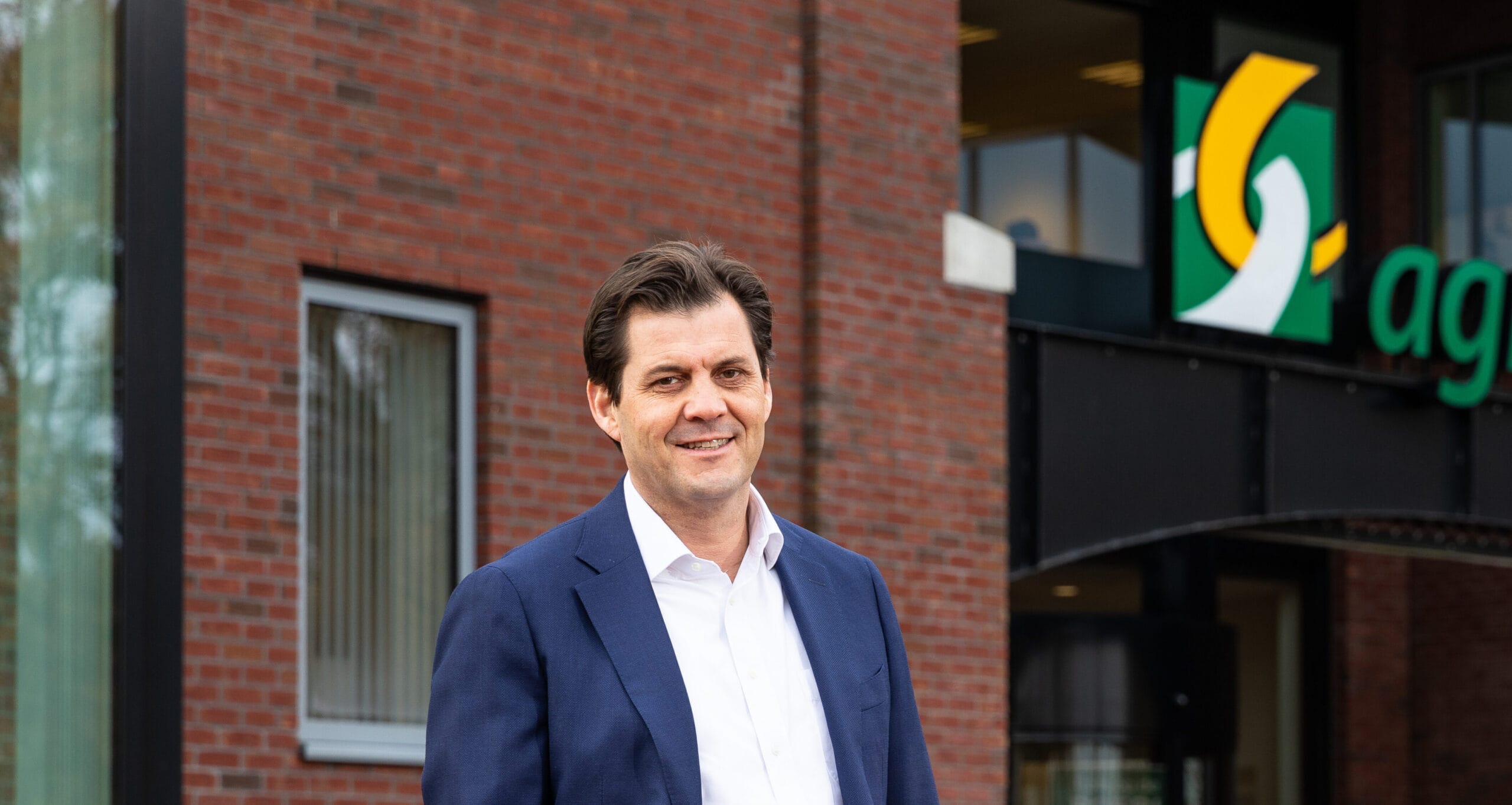
Willem Unger
Director Agrifirm Plant-Based & Group Director R&D & Data Intelligence
Agrifirm
"I am convinced that we can do much more with technology and data, so that growers can produce more profitably and sustainably."
Agrifirm is a cooperative in which around 8,000 Dutch livestock farmers and growers have pooled their purchasing power. The Plant-Based division supplies everything growers need to achieve good results in cultivation. Think of seeds, fertilizers, and crop protection products. "Our strength? Extensive access to the farmyard, the field, and a good relationship with the grower. Our customers value us not primarily for our products. In agriculture, it's about trust and return. Our people, our knowledge, and advice are what sets us apart," says Willem Unger, responsible for the plant-based division of Agrifirm since 2019. It includes approximately 4,000 plant-based growers in the open air.
You come from horticulture. What attracted you to Agrifirm?
"For a long time, I worked for Syngenta, a Swiss company involved in seed breeding and agrochemical development. Agrifirm attracted me, among other reasons, because of its mission: a responsible food chain for future generations. Additionally, the challenges in the agricultural sector appealed to me. Horticulture is about ten to twenty years ahead of agriculture in terms of technology and data use. This is not surprising because in greenhouse cultivation, you have a significant impact on growing conditions, and the size of the area to monitor and therefore investments are smaller. Decisions are already much more data-driven there, rather than solely based on experience and intuition. My experience in the horticulture sector has convinced me that there is much to gain in outdoor cultivation with technology as well."
You returned from Switzerland in 2019 after 10 years. What stood out to you in the agricultural sector in the Netherlands?
"I returned at the time of the farmers' protests at the Malieveld. There was little understanding between public opinion, the ruling politics, and the farmers. Society's concerns about the environmental impact of the agricultural sector were at odds with the farmers' concerns. Understanding between them has improved somewhat in recent years, but farmers still feel that much legislation leads to cost-increasing measures. Margins are already thin. More than a third of farmers live at subsistence level. This makes them feel: how can we be environmentally friendly when we are in the red?"
How does Agrifirm address these concerns?
"We believe it is a false dichotomy that farmers are only concerned with making money, and the government is solely focused on nature conservation. People forget that the land is the farmer's most valuable asset. I see many farmers who care about nature, but almost all risks currently lie with the agricultural company. This rightly raises concerns about the business model. Agrifirm serves about 40 percent of the agricultural land in the Netherlands. This means that we can truly play a role in connecting the economy and ecology on the farm."
How do you do that?
"Chemical crop protection and various forms of fertilizers are under scrutiny. There has already been a significant reduction in the past ten years: around 80 percent of all chemical authorizations will have disappeared between 2018 and 2027. With the aim of reducing environmental impact. At the same time, this means fewer tools for farmers to control diseases and pests. In other words: more risks in cultivation and therefore for the grower's return. The phasing out of synthetic chemicals creates challenges and issues for the farmer. As Agrifirm, we can help them with our solutions."
Can you tell us more about your solutions?
“To a large extent, it involves technical innovations. For years, we have been investing heavily in research and development of digital systems. By using much more data, a farmer can better assess risks. This means fewer costs, because using synthetic products is expensive. Additionally, it reduces environmental impact on the surroundings.”
“For the past three years, we have been sharing this knowledge and innovations with our growers. Think of forms of precision agriculture, digital advisory tools, and emission reduction techniques. We call it the Total Crop Approach. For example, we have developed digital plant growth models. By entering weather data, a grower has 95 percent predictability of when a certain disease or fungus is likely to occur. This allows him to use crop protection products much more effectively. There are also possibilities in mechanization, such as weed robots and spot sprayers. An AI-based camera system recognizes the difference between crops and weeds.”
Are these solutions as effective for growers as crop protection products?
“All these techniques are not as effective on their own as crop protection products. You have to see it as putting together a puzzle to come to a complete solution with the grower. We have proven that it is possible. With our Total Crop Approach, we focus on preventive cultivation strategies. We bring together synthetic products, green products, biostimulants, mechanization, and digitalization. It comes down to customization: what does a grower need for his agricultural business? Our role is to advise growers and guide them well to still achieve a good return on their farm through these changes.”
What impact do these developments have on your business model?
“Our business model becomes less dependent on synthetic products. Previously, we earned our money from product sales, and knowledge came free with the products. Chemistry has the advantage that it always provides the same result, regardless of conditions or soil type. The world we are moving towards – less chemistry and more technical solutions – is more complex. Therefore, knowledge and advice become more valuable. This offers perspective for a new revenue model.”
Is this a major shift within the company?
“What's nice to see is: ten years ago, the glass was half empty. The feeling was: ‘Less chemical products? Difficult, that's not possible.’ Now the glass is half full, and the Agrifirm team is convinced that there are indeed real possibilities. This gives energy and optimism. It offers good prospects for the coming years to further develop these technical and digital solutions and thus increase our competitive advantage. In this way, we are part of the solution, rather than part of the problem. Agrifirm is thus becoming more value-driven. We want to turn this into growth.”
What does this shift require from your people?
“Our people are strongly grounded in agronomy. Previously, the focus was on advising on the application of products. In the coming years, it will increasingly be about advising on a complete solution and then positioning it well in the market. We offer our people development programs and traineeships. And we are increasingly working in teams with various specialists. This way, we can better serve our customers.”
What does Agrifirm offer to new people?
“We are strongly professionalizing, innovating, and growing. Because we are reinventing ourselves in many ways and much of what we do is new, this allows for a lot of personal input. We are working together on the solutions of tomorrow. That's the culture that prevails here. Change comes from the bottom up, not from the top down. Agrifirm invests a lot in its people because people make the difference. You are an advisor and truly stand beside the farmer. We offer a great environment to develop yourself.”